%20--%3e%3csvg%20version='1.1'%20id='Layer_1'%20xmlns='http://www.w3.org/2000/svg'%20xmlns:xlink='http://www.w3.org/1999/xlink'%20x='0px'%20y='0px'%20viewBox='0%200%20546.4%2051'%20style='enable-background:new%200%200%20546.4%2051;'%20xml:space='preserve'%3e%3cstyle%20type='text/css'%3e%20.st0{fill:%23172A80;}%20.st1{fill-rule:evenodd;clip-rule:evenodd;fill:%23F5A623;}%20%3c/style%3e%3cg%3e%3cpath%20class='st0'%20d='M14.9,9.1H0V1.2h38.4v7.8H23.5v40.7h-8.6V9.1z'/%3e%3cpath%20class='st0'%20d='M53,1.2h7.5l20.9,48.5h-9.9L67,38.7H45.9l-4.4,11.1h-9.7L53,1.2z%20M64,31.3l-7.5-19.7l-7.6,19.7H64z'/%3e%3cpath%20class='st0'%20d='M86.1,1.2h11.5l23.5,36.1h0.1V1.2h8.6v48.5h-11l-24-37.2h-0.1v37.2h-8.6V1.2z'/%3e%3cpath%20class='st0'%20d='M183.2,46.2c-6,3.2-12.7,4.8-20.1,4.8c-3.7,0-7.2-0.6-10.3-1.8c-3.1-1.2-5.8-2.9-8.1-5.1c-2.3-2.2-4-4.9-5.3-8%20c-1.3-3.1-1.9-6.6-1.9-10.4c0-3.9,0.6-7.4,1.9-10.6c1.3-3.2,3.1-5.9,5.3-8.1c2.3-2.2,5-4,8.1-5.2c3.1-1.2,6.6-1.8,10.3-1.8%20c3.7,0,7.2,0.4,10.4,1.3c3.2,0.9,6.1,2.5,8.7,4.8l-6.4,6.4c-1.6-1.5-3.4-2.7-5.7-3.5c-2.2-0.8-4.6-1.2-7-1.2%20c-2.5,0-4.8,0.4-6.8,1.3c-2,0.9-3.8,2.1-5.2,3.7c-1.5,1.6-2.6,3.4-3.4,5.5c-0.8,2.1-1.2,4.4-1.2,6.8c0,2.6,0.4,5,1.2,7.2%20c0.8,2.2,1.9,4.1,3.4,5.7c1.5,1.6,3.2,2.9,5.2,3.8c2,0.9,4.3,1.4,6.8,1.4c2.2,0,4.3-0.2,6.2-0.6c1.9-0.4,3.7-1.1,5.2-1.9V29.2h-9.9%20v-7.8h18.6V46.2z'/%3e%3cpath%20class='st0'%20d='M190.1,25.7c0-3.9,0.6-7.4,1.9-10.6c1.3-3.2,3.1-5.9,5.3-8.1c2.3-2.2,5-4,8.1-5.2C208.5,0.6,212,0,215.7,0%20c3.8,0,7.3,0.5,10.4,1.7s5.9,2.9,8.2,5.1c2.3,2.2,4.1,4.9,5.3,8.1c1.3,3.2,1.9,6.7,1.9,10.6c0,3.8-0.6,7.2-1.9,10.4%20c-1.3,3.1-3.1,5.8-5.3,8c-2.3,2.2-5,4-8.2,5.2s-6.6,1.9-10.4,2c-3.7,0-7.2-0.6-10.3-1.8c-3.1-1.2-5.8-2.9-8.1-5.1%20c-2.3-2.2-4-4.9-5.3-8C190.7,33,190.1,29.5,190.1,25.7z%20M199.1,25.2c0,2.6,0.4,5,1.2,7.2c0.8,2.2,1.9,4.1,3.4,5.7%20c1.5,1.6,3.2,2.9,5.2,3.8c2,0.9,4.3,1.4,6.8,1.4c2.5,0,4.8-0.5,6.9-1.4c2.1-0.9,3.8-2.2,5.3-3.8c1.5-1.6,2.6-3.5,3.4-5.7%20c0.8-2.2,1.2-4.6,1.2-7.2c0-2.4-0.4-4.7-1.2-6.8c-0.8-2.1-1.9-3.9-3.4-5.5c-1.5-1.6-3.2-2.8-5.3-3.7c-2.1-0.9-4.3-1.3-6.9-1.3%20c-2.5,0-4.8,0.4-6.8,1.3c-2,0.9-3.8,2.1-5.2,3.7c-1.5,1.6-2.6,3.4-3.4,5.5C199.5,20.5,199.1,22.7,199.1,25.2z'/%3e%3c/g%3e%3cg%3e%3cg%3e%3cpath%20class='st0'%20d='M268.8,1.2H301v7.8h-23.5V21h22.3v7.8h-22.3V42h24.8v7.8h-33.4V1.2z'/%3e%3cpath%20class='st0'%20d='M378.8,9.1h-14.9V1.2h38.4v7.8h-14.9v40.7h-8.6V9.1z'/%3e%3cpath%20class='st0'%20d='M407.5,1.2h32.2v7.8h-23.5V21h22.3v7.8h-22.3V42h24.8v7.8h-33.4V1.2z'/%3e%3cpath%20class='st0'%20d='M448.7,1.2h11.5l23.5,36.1h0.1V1.2h8.6v48.5h-11l-24-37.2h-0.1v37.2h-8.6V1.2z'/%3e%3cpath%20class='st0'%20d='M502.6,1.2h19.1c3.2,0,6.3,0.5,9.3,1.5c3,1,5.6,2.5,7.9,4.5c2.3,2,4.1,4.5,5.5,7.6c1.4,3,2.1,6.6,2.1,10.7%20c0,4.2-0.8,7.8-2.4,10.8c-1.6,3-3.6,5.6-6.1,7.5c-2.5,2-5.3,3.5-8.3,4.5c-3,1-6,1.5-8.9,1.5h-18.1V1.2z%20M517.7,42%20c2.7,0,5.2-0.3,7.6-0.9c2.4-0.6,4.5-1.6,6.3-2.9c1.8-1.3,3.2-3,4.2-5.1c1-2.1,1.5-4.6,1.5-7.6c0-2.9-0.5-5.4-1.4-7.5%20c-0.9-2.1-2.2-3.8-3.8-5.1c-1.6-1.3-3.5-2.3-5.8-2.9c-2.2-0.6-4.7-0.9-7.3-0.9h-7.9V42H517.7z'/%3e%3c/g%3e%3cg%3e%3cpolygon%20class='st0'%20points='348.8,1.3%20338.5,17%20328.3,1.3%20315.8,1.3%20332.1,25.1%20315.1,49.8%20327.3,49.8%20338.2,33.2%20349.1,49.8%20361.6,49.8%20344.7,25%20360.9,1.3%20'/%3e%3cg%3e%3cpolygon%20class='st1'%20points='306.4,1.2%20322,25%20305.4,49.9%20310.2,49.9%20327,25%20311.2,1.2%20'/%3e%3c/g%3e%3c/g%3e%3c/g%3e%3c/svg%3e)
PSTN Replacement in the UK: Why Mobile Connectivity Is the Answer for Lines You Can't Rewire
The countdown to 31 January 2027
The UK's analogue phone network has a firm end date. BT Group will retire the Public Switched Telephone Network (PSTN) by 31 January 2027, and Openreach has made clear the deadline is locked. Wholesale Line Rental (WLR), ISDN and the copper-based services that ride on them go with it.
Most of the conversation so far has been about home phones and office lines. Those are the easy part: move the number to a digital line, plug the handset into the router, job done.
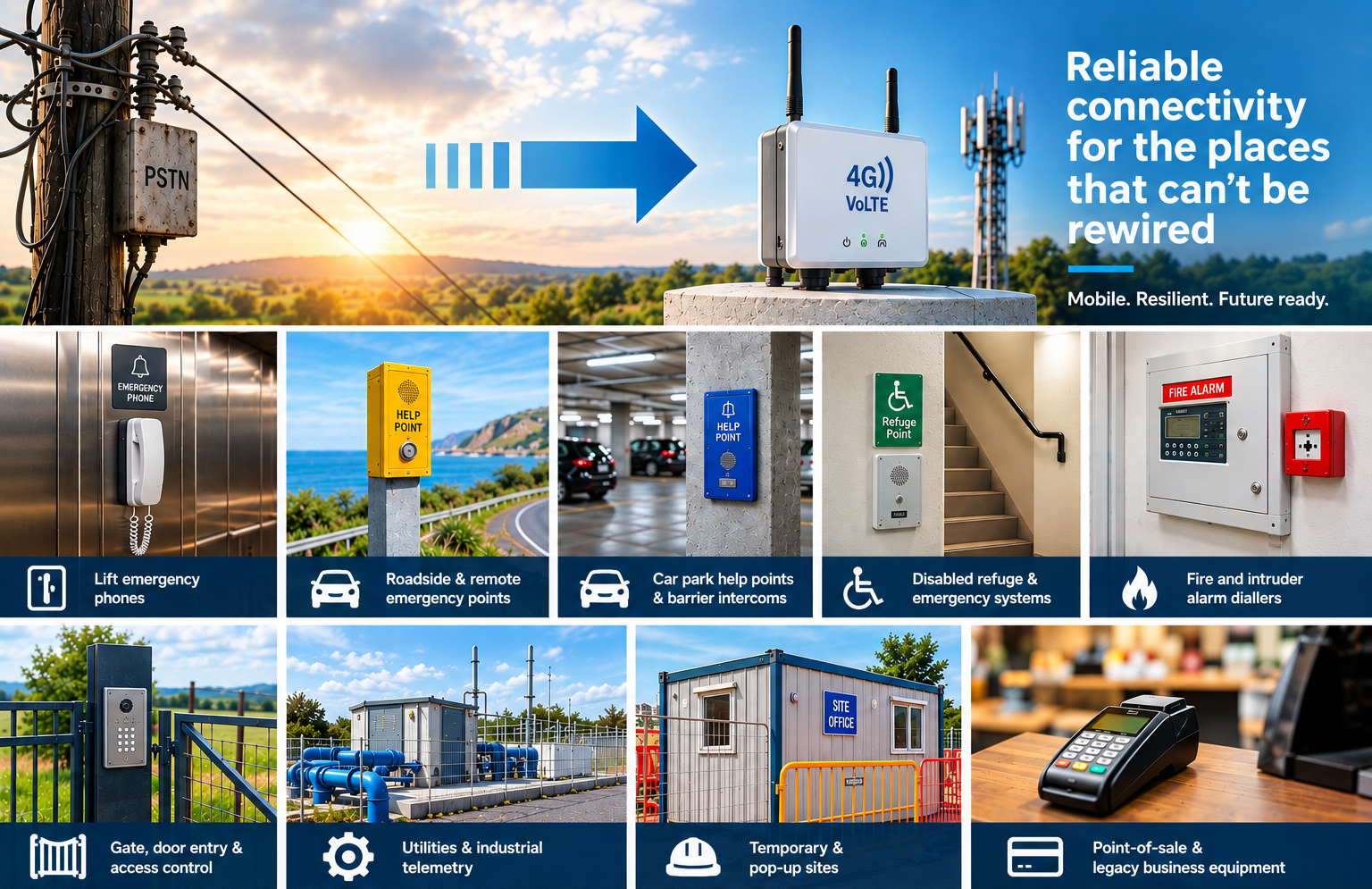
The harder part is everything else that quietly uses a phone line. Lift emergency phones. Fire and intruder alarm diallers. Car park help points and barrier intercoms. Gate entry systems. Equipment in plant rooms, pump stations and roadside cabinets. Many of these were installed years ago on a copper pair nobody has thought about since, and many sit in places where a broadband connection simply doesn't exist.
Earlier this year Openreach reported roughly 2.8 million lines still on the PSTN, with more than half a million serving business premises. A significant share of those aren't phones at all. They're devices, and they need a different answer.
Why "just move it to broadband" doesn't work for everything
The standard migration path is a digital line (SOGEA or full fibre) with an analogue telephone adapter behind the router. That works well in an office. It works much less well for a lift car in a shaft, a help point at the far end of a car park, or a cabinet on a rural road.
Three problems come up again and again:
There's no cable to reuse. The copper pair may be the only line into that location, and once it stops carrying PSTN service, there is often no fibre route to replace it. Digging a new trench to a single emergency phone is rarely economical.
Power becomes a dependency. A copper line was powered from the exchange. A digital line depends on the router, the Optical Network Terminal (ONT) and the building's electricity. If the power fails, so does the phone, which is exactly when a lift phone or alarm is most likely to be needed.
Shared IT networks add risk. Putting a life-safety device on the building's LAN ties it to firewall changes, router replacements and ISP faults that have nothing to do with it. Every one of those is a chance for an emergency line to go silent without anyone noticing.
Openreach's temporary emergency service for lines that miss the deadline is priced at a premium and designed only as a short-term safety net. It buys time. It doesn't solve the problem.
Mobile is the natural replacement, but only if it's built for voice
For devices that can't be cabled, cellular connectivity is the obvious answer. A small gateway with a SIM (or eSIM) connects the existing analogue device to the mobile network. There's no dependency on the building's broadband, and a gateway with a battery backup keeps working through a power cut.
The catch is in the SIM. Many PSTN replacement projects reach for the cheapest option: a data-only IoT SIM paired with an analogue adapter that turns voice into VoIP traffic. On paper it looks economical. In practice, generic data SIMs give voice no priority on the network. The result is choppy audio, dropped calls and unreliable call setup.
That's an annoyance on a desk phone. On a lift alarm, a fire panel or a refuge intercom, it's a compliance, safety and liability problem.
VoLTE (Voice over LTE) is different. It isn't "voice over data". It's the carrier-grade voice service the mobile networks use for ordinary phone calls, with its own quality-of-service treatment. VoLTE calls get prioritised traffic, fast and stable call setup, and consistent, landline-like audio.
Timing matters here too. The UK's 3G networks have already been switched off, and legacy mobile voice is being wound down. Any device installed now should be on 4G/5G with VoLTE, so it won't face a second migration in a few years.
Where mobile PSTN replacement makes the most sense
Lift emergency phones are the best-known example, but they're far from the only one. If a device needs a phone line and running a new cable to it is impractical, it's a candidate.
Lift emergency phones. Lift alarms must connect trapped passengers to a rescue service around the clock. A VoLTE gateway in the lift motor room or car avoids the building network entirely, and a battery-backed unit keeps the line alive during the power cut that stranded the lift in the first place.
Roadside and remote emergency points. Help points on private roads, bridges, tunnels, level crossings, reservoirs and country parks are often miles from any fibre. Mobile is frequently the only practical connection.
Car park help points and barrier intercoms. Spread across multi-storey and surface car parks, often with no network cabling nearby.
Disabled refuge and emergency voice communication systems. Refuge points in stairwells need a reliable outside line for when the building's own systems are compromised.
Fire and intruder alarm diallers. Signalling to an alarm receiving centre needs a dependable path that doesn't fail when the router does.
Gate, door entry and access control. Estate gates, farm entrances and industrial sites where the intercom dials out to a phone.
Utilities and industrial telemetry. Pump stations, substations, water treatment and pipeline sites with legacy diallers and remote monitoring.
Temporary and pop-up sites. Construction site cabins, events, vaccination or testing centres and seasonal kiosks that need a working phone line fast and don't need it forever.
Point-of-sale and legacy business equipment. Card terminals, franking machines, ticket machines and vending kiosks that still dial out over a phone line.
The common thread: the device matters, the cable is the problem, and the line has to work every single time it's used.
How Tango Expand delivers PSTN replacement
Tango Networks built Tango Expand to replace PSTN and close the gap between cheap-but-unreliable data SIMs and expensive traditional lines. It's a VoLTE-capable SIM, priced competitively with low-cost data plans, but tuned specifically for voice-dependent legacy devices.
Voice first. Calls run over VoLTE with carrier-grade quality of service, not as best-effort VoIP over a data bearer.
Physical SIM or eSIM. Use a traditional SIM in existing gateways, or an eSIM that's provisioned remotely with no site visit to swap cards.
Works with the kit you already have. Tango Extend is designed to sit behind proven analogue gateways, so lift phones, alarm diallers and intercoms keep working without being replaced.
Remote management. Activate, monitor, suspend or move lines centrally across an estate of hundreds or thousands of endpoints.
Keep your numbers. Existing numbers can be retained, so alarm receiving centres and rescue services don't need reprogramming.
Built for partners. Tango Extend is sold through service providers, MSPs and integrators, who can wrap it into their own PSTN migration offer.
The principle is simple: don't skimp on the part that matters most, the voice call, to save money on the part that matters least.
Five steps to take before the switch-off
With only months left, the organisations that migrate calmly will be the ones that start with an inventory rather than a deadline.
Audit every line. List every number and circuit on the bill, then find what's actually plugged into it. Lines that nobody can explain are often alarms or lift phones.
Separate phones from devices. Handsets and office lines can usually move to a digital or UC service. Devices need their own plan.
Identify the hard-to-reach sites. Flag anything in a lift shaft, plant room, car park, roadside location or remote site where new cabling is impractical.
Check power resilience. Confirm which devices must keep working during a power cut, and specify battery-backed gateways for them.
Test before you switch. Make test calls to the alarm receiving centre or rescue service, confirm call quality, and record the results for compliance before the copper line is ceased.
The bottom line
The PSTN switch-off isn't just a telephony upgrade. For anyone responsible for buildings, infrastructure or life-safety systems, it's a resilience project. The devices that are hardest to reach are usually the ones that matter most when something goes wrong.
Mobile connectivity removes the cable problem. VoLTE removes the voice-quality problem. Tango Extend brings the two together at a price that makes it realistic to migrate every lift, alarm and help point, not just the easy ones.
Find out more information and Talk to Tango Networks or one of our UK partners about PSTN replacement with Tango Extend, and make sure 31 January 2027 passes without a single silent line.
Sources
Better Business · Sustainability
When did you last calculate the true total cost of your corporate mobile fleet — including IT management time, repairs and replacements?
The device purchase is the visible cost. IT management time, insurance, repair, replacement, contract admin and expense processing can double or triple the headline number. Tango Extend eliminates the corporate device entirely for BYOD deployments.